Help - Host Controls

Realtime Playtest

Host Controls

Host-only table controls: Room Options for hand visibility, drag to hand, auto-flip when drawn, personal decks and admin mode, plus background color, syncing components, project dependencies, free scale, and designer notes.

Host Controls

As the host you're the table's stage manager. This page covers the host-only controls for shaping the space. Several of the bigger ones have their own guides, linked below.
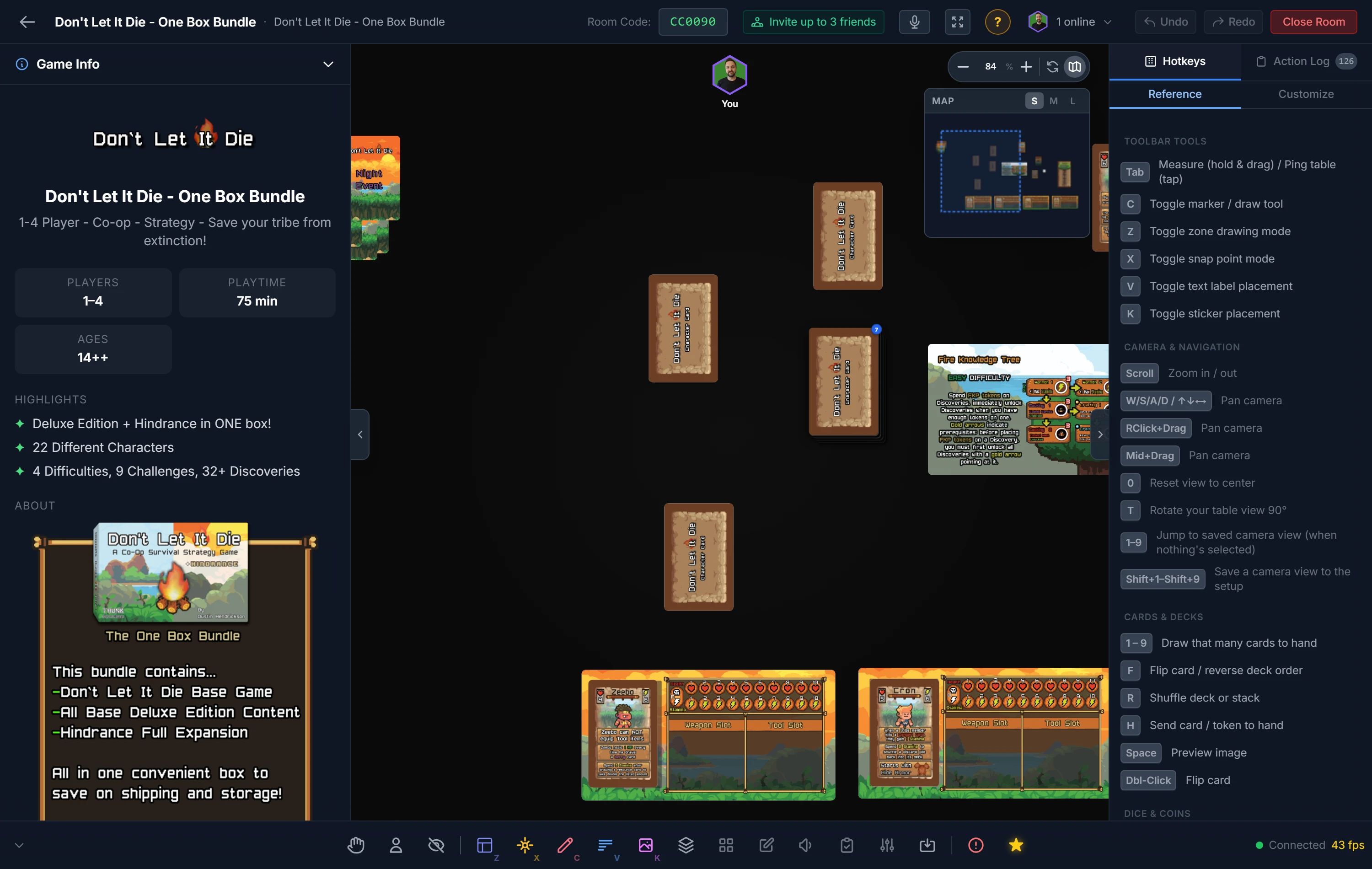
The host's expanded toolbar along the bottom, with the extra host-only tools, plus Undo, Redo, and Close Room in the top bar

Note

Co-hosts share host powers, with one exception: Admin mode only reveals hands and hidden zones for the room's creator. To promote a co-host, and for the full who-can-do-what breakdown, see Players, Hosts & Co-Hosts.

Shaping the Table

  • Table background color: a picker in the bottom controls; it broadcasts to everyone live. Use it to set a mood or mark teams.
  • Project dependencies: pull another project's components into this room (see below).
  • Free Scale: to resize a piece to an exact size, right-click it, open the Scale row, and choose Free. Drag the corner handles, then click Done. (For uniform 25% steps, just press + and -.)
  • Room Options: the table grid, plus what players can see and do at this table (see below).

Room Options

Open Room Options in the bottom toolbar. Only hosts see this panel. Everything in it applies to every player at the table and takes effect straight away. Most of it starts neutral: the switches off and the two overrides on Player Choice. The exceptions are Allow saving & loading game progress, which starts on, and Auto-Lift, which starts at 50%.

Tip

Room options are saved as part of a Saved Table Setup, so loading a setup brings back the options it was saved with. A setup only restores the options it actually recorded, so an older setup leaves anything newer untouched.

Grid

An alignment lattice over the whole table, so pieces click into place instead of landing wherever the mouse let go. Turn on Show grid to draw it, Snap pieces to it to actually pull pieces onto it, and set the type, size, line color and snap location to suit the game. Full detail, including per-board grids, is in Grids & Snapping.

Hand visibility

  • Show hand counts: players can see how many cards each other is holding, but not what those cards are.
  • Open hands: every player's hand cards are visible to everyone. Use it for a teaching game, a solo test, or a post-game review.

Drag to Hand

Whether players can drag components off the table into their hand. Three settings:

  • Player Choice (the default) leaves it to each player's own preference.
  • Force On enables it for everyone, ignoring their preference.
  • Force Off disables it for everyone.

Auto-Lift

Dragging a card, token or board carries whatever is sitting on top of it. This sets how much of that piece has to be over the one below before it comes along: a slider from 1% to 100%, starting at 50%.

  • Low carries anything that so much as clips a corner, which is useful when pieces are meant to sit loosely against each other.
  • 50% means a piece has to be at least half on before it travels.
  • 100% carries only what sits squarely on top of the piece underneath.

It is measured per layer, against the piece directly beneath rather than the one you grabbed, so a token on a card on a board is judged against the card. Full detail on what does and does not travel, including the per-piece Prevent Auto-Lift restriction, is in Moving & Arranging Objects.

Auto-flip when drawn

Which way up a card lands when it goes into a player's hand, however it got there: drawn from a deck, dealt, picked up off the table, or passed from another player. Four settings:

  • Player Choice (the default) leaves it to each player's own preference. New players start on Face Up.
  • None means cards keep the face they already had.
  • Face Up and Face Down force that face for everyone, ignoring their preference.

Players still see their own buttons in the hand settings, marked with a Host badge so it is clear the choice is not theirs while you are forcing one.

Personal decks

Decide whether players may save decks from this table to a file, load their own deck files into it, or both. See Personal Decks.

Allow copy, paste & duplicate is the third switch here. Copying is host-only until you turn it on; once you do, every player can use Ctrl+C, Ctrl+V, and Ctrl+D on table objects, plus Copy and Duplicate in the right-click menu. Turn it on when players are building their own decks, since that needs more than one copy of a card.

Game progress

Allow saving & loading game progress lets any player at the table save the whole game, hands included, to a sealed file on their own computer and load it back later. It is on by default, because the sessions that need it most are the ones you are not attending, and those are exactly the ones where nobody present could switch it on. Turn it off if a game should not be resumable, and save the setup to make that stick. See Saving Game Progress.

Admin mode

Shows you every player's hand and the contents of hidden zones. It changes your view only; nothing about the table changes for anyone else, and no player is told it is on.

Note

Admin mode works for the room creator only. A co-host can switch it on, but it will not reveal anything for them. Every other room option works the same for hosts and co-hosts.

Project Dependencies

A room is started from one project, but you can pull in the components of other projects as dependencies. Their cards, tokens, boards, and everything else show up in the room's left sidebar alongside the host project's pieces, ready to spawn onto the table. This is how you playtest an expansion against its base game, combine separate modules, or reuse a shared component library without copying anything.

To add a dependency:

  1. In the room's left sidebar, click Add Project Dependency (above the Game Info section).
  2. A picker lists the projects you own, minus this room's own project and any already added.
  3. Click a project to attach it. Its components appear right away as a new collapsible section in the sidebar.
  4. To detach it, click the remove (×) control next to the dependency's name. Removing it clears the sidebar section; pieces already spawned on the table stay put.

Note

Dependencies are host-only to add or remove (co-hosts included), and you can only add projects you own. You can't add the room's own project to itself.

Tip

Dependencies are remembered by Saved Table Setups: saving a setup records its attached projects, and loading that setup re-attaches them so the same combined pool is ready next time.

Keeping Data in Sync

  • Sync from Database (): re-fetch your components and push any changes onto matching pieces already on the table. Edited a card's art in another tab? This brings it in.
  • Dextrous Sync: if a Dextrous feed is configured, re-import external component data. See Dextrous Import.
  • Fresh Room: open a brand-new, empty room for this project without leaving your session, handy for a clean test table. See Starting & Joining Rooms.
  • Editing a single piece: right-click any component-linked piece to edit, restore, or save its definition. See Editing & Syncing Components.

Designer Notes (Action Items)

Capture thoughts mid-session without breaking your flow. Right-click empty table and choose Add Action Item, type the note, and Save Note (or press Ctrl+Enter). Notes are private to you and appear on your project dashboard and the linked session page, where you can check them off as you address them.

More Host Tools

Each of these has its own guide:


Related: Players, Hosts & Co-Hosts · Editing & Syncing Components · Saving Game Progress · Realtime Playtest overview